

Blog
Assimilation: The Powerful Reality of Cultural Lifestyle


Have you ever thought about what it’s really like to start over when everything is so unfamiliar. Cultural assimilation is not just an intellectual exercise. It’s the lived reality of millions of people who feel they are caught between two worlds and two identities.
What Exactly Is Cultural Assimilation?
Acculturation occurs when an individual picks up the beliefs, practices and traits of another culture over time. It informs every aspect of daily life, from language to food, clothing and even the names you choose for your children.
This idea is distinct from related concepts such as acculturation (two-way exchange of culture) and integration (joining society but retaining your heritage). Assimilation means even greater adoption of the dominant culture.
The Two Types of Assimilation
So not all assimilation is voluntary. Understanding that this difference is critical to understanding its psychological impact.
Voluntary Assimilation when individuals wish to be part of their new cultural lifestyle. They learn to speak the language, sample new forms of nourishment and befriend local people because they’re curious and wish to belong.
Involuntary assimilation is when dominant groups demand that minorities surrender their cultural identity. There are many instances in history of peoples being compelled to eliminate their languages and traditions. This kind of assimilation can be extremely emotionally scarring.
The Four Stages of Cultural Assimilation
Researchers have identified distinct stages people move through when adapting to a new culture:
- Contact Stage – First arrival when everything feels unfamiliar and you’re mostly observing
- Accommodation Stage – Making initial adjustments while holding tight to your original culture
- Adaptation Stage – Deeper cultural learning where you begin to thrive, not just survive
- Full Assimilation Stage – The distinction between original and adopted culture becomes minimal
Not everyone reaches the final stage, and many find a comfortable middle ground instead.
The Psychological Impact of Assimilation
Assimilation can be emotionally challenging. Behind statistics about language acquisition, real people experience real struggles.
Cultural Bereavement is a form of grief for your lost culture and homeland. Every time you forget a word in your native language, you feel that loss.
Identity Confusion becomes challenging when you don’t quite fit anywhere. Your old community thinks you’ve changed too much, but your new home still sees you as foreign.
Research shows assimilation can lead to increased anxiety and depression, especially when people feel pressured to abandon their heritage completely.
How Assimilation Affects Families
One of the most painful aspects of assimilation involves family relationships. Parents and children often adapt at different speeds.
Children typically absorb the dominant culture faster than their parents. They become fluent in the local language while their parents still struggle. This creates role reversals where children interpret culture for their families.
Common family challenges include:
- Parents worrying about children losing their heritage
- Children feeling embarrassed by “old-fashioned” parents
- Conflict over traditional practices versus fitting in
- Communication gaps as children lose fluency in their native tongue
Families that honor their heritage while embracing their new home tend to produce children with better mental health outcomes.
The Benefits of Cultural Assimilation
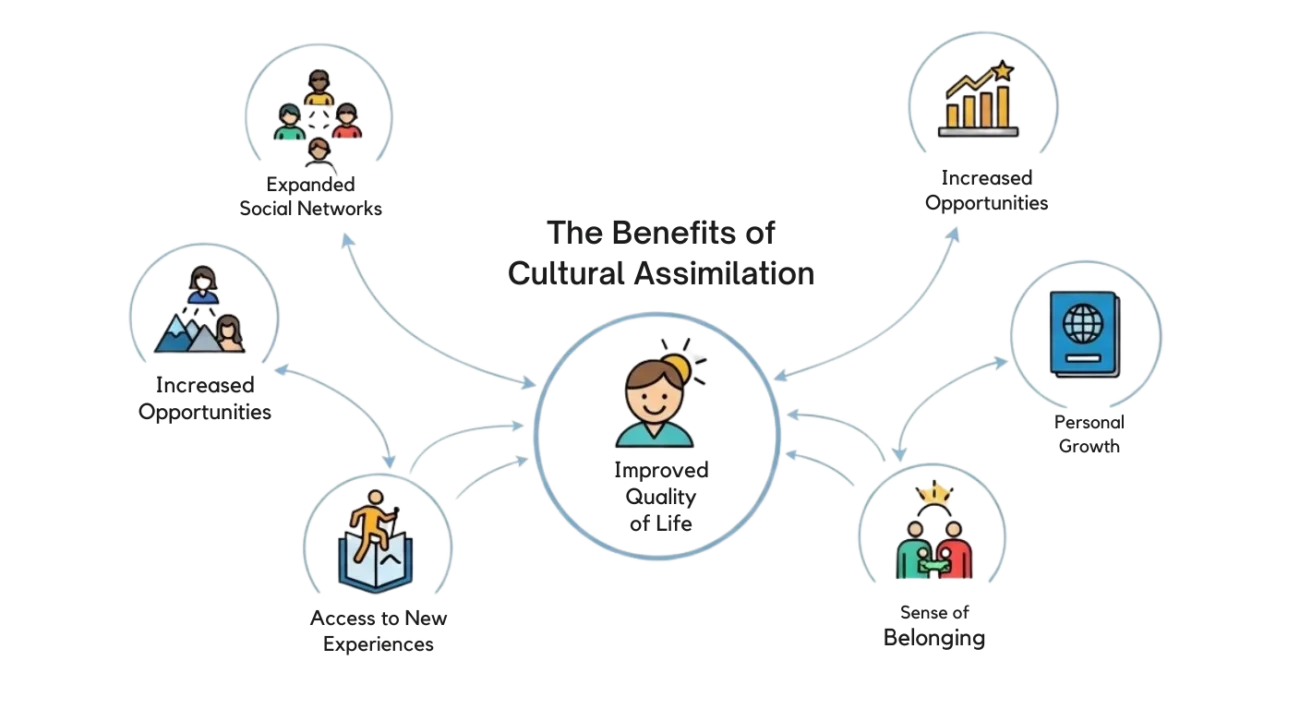
When assimilation happens under good conditions, it brings real benefits that shouldn’t be overlooked.
- Economic Advancement – Language proficiency links to better employment and higher wages. Learning English can improve immigrant earnings by over 33 percent.
- Social Connection – As cultural barriers decrease, people form deeper relationships with neighbors and colleagues, building valuable support networks.
- Broader Horizons – People who navigate assimilation successfully develop cultural intelligence, becoming skilled at functioning across different cultural contexts.
- Resilience – Children of immigrants often develop remarkable adaptability and learn to read social situations quickly.
Why Biculturalism Works Best
Recent research reveals something surprising: full assimilation isn’t the best outcome for well-being. The healthiest approach is biculturalism maintaining heritage connections while participating in the dominant culture.
Studies show bicultural individuals report:
- Higher self-esteem
- Less anxiety and depression
- Better family relationships
- Greater life satisfaction
Your original culture shapes who you are. Abandoning it entirely means losing part of your identity. But closing yourself off from your new culture means missing opportunities for growth. The sweet spot is learning to hold both.
What Host Societies Can Do Better
Assimilation isn’t just about what immigrants do. It’s also shaped by how receiving societies respond.
- Create Genuine Welcome – Provide resources like language classes and job training while making space for cultural difference.
- Recognize Mutual Benefit – Immigrants bring new perspectives, skills, and cultural richness that enrich communities.
- Address Discrimination – Prejudice remains a major barrier. Experiences of racism significantly worsen mental health outcomes for immigrants.
Communities that embrace diversity while supporting adaptation create conditions where everyone thrives.
FAQs
How long does cultural assimilation take?
Significant adaptation occurs within about 20 years. Full assimilation often spans multiple generations, with grandchildren having minimal connection to the ancestral homeland.
Is assimilation the same as losing your culture?
Not necessarily. People can learn new cultural skills without abandoning their identity. The healthiest outcomes occur when people maintain connections to both cultures.
What’s the difference between assimilation and acculturation?
Acculturation describes cultural changes when different cultures meet and can involve both groups changing. Assimilation specifically refers to minorities adopting the dominant culture’s norms.
Do children face different challenges than their parents?
Yes. Second-generation immigrants often struggle with identity, not feeling fully accepted by either culture. School years tend to be especially challenging.
Can assimilation be reversed?
In some ways, yes. Many people who assimilated heavily later develop renewed interest in their heritage through language learning and reconnecting with cultural practices.
What role does language play?
Language is the single most important factor. It unlocks participation in education, employment, and social life. People arriving before age nine typically achieve native-like proficiency.
Final Thought
There are plenty of perils associated with cultural assimilation, but it’s not all bad or good either just a very human thing that happens depending on time and place, circumstance and choice, community support. The research is clear that integrating links to your heritage and new cultural skills leads to the best outcomes for everyone. So in your own trajectory or in the new faces you welcome to your shores, think small, slow and diverse because the healthiest forms of integration are mutual. We all have something we can contribute, and we all have something to gain.